If you’re comparing Digital PR quotes, you probably want to know why one provider charges more than another and whether the extra cost is worth it. The price is part of that decision, but I would also want to know how much work each provider expects you to do.
One might manage the research, design and outreach, while another expects your team to supply a finished story. You could pay less for the second option, but that saving comes with work you still need to find time for. So before comparing the fees, I would look at what each quote actually covers.
What does Digital PR cost in Australia?
For a published reference, Otto Media’s Canberra pricing guide, checked on 8 September 2026, lists monthly retainers of $3,000 to $8,000+ and projects of $5,000 to $20,000+. Those are one provider’s guide prices, not an Australian market average or my fees. You would still need the provider to confirm the currency, GST treatment and inclusions for your quote.
The cost depends partly on what needs to be produced. If you already have someone who can explain a subject well, an expert contribution may need relatively little production. But if the campaign depends on original research, there could be data collection, analysis, writing and design before anyone has a story to offer a publisher.
Both can be sold as Digital PR, even though you’re paying for quite different amounts of work. That’s why a monthly fee tells you very little until you know what is included and what your team will be responsible for.
Why the lower quote is not always the lighter commitment
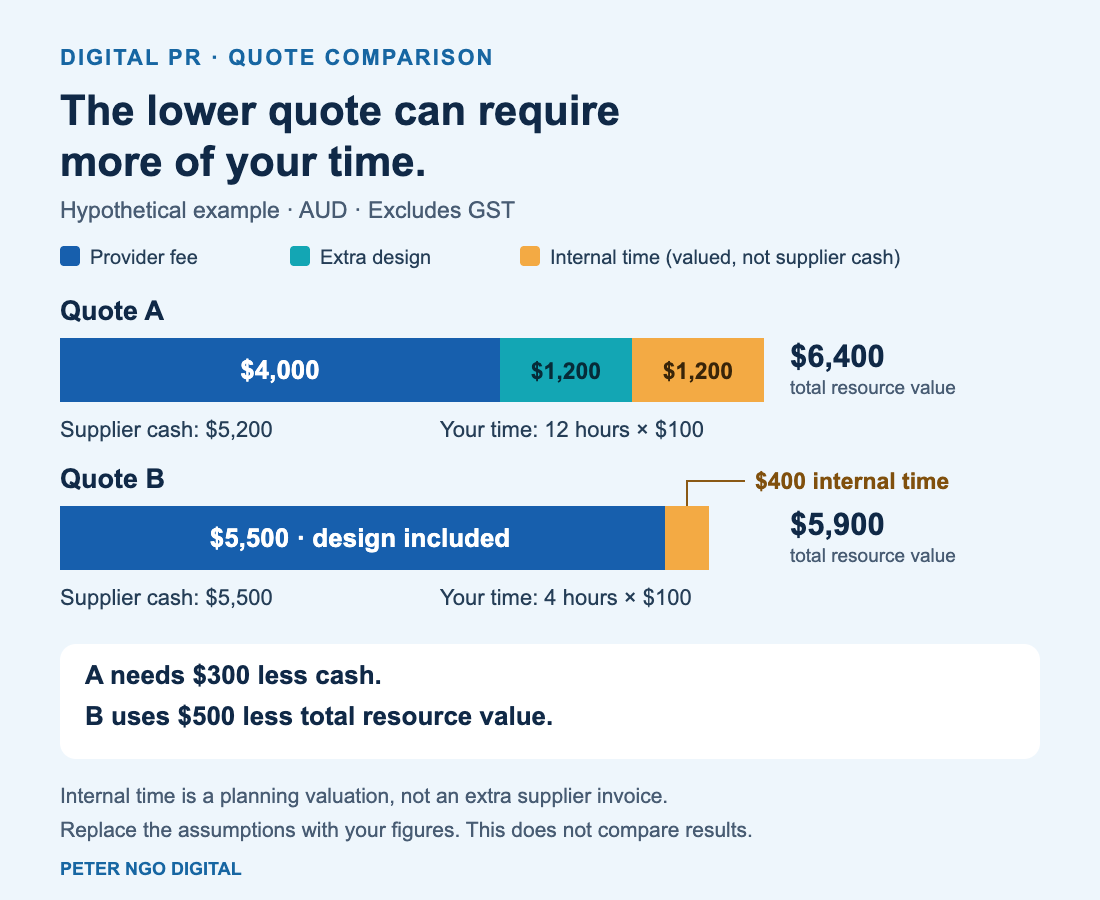
Let’s say you receive the two quotes shown below. These are invented figures in Australian dollars excluding GST. Quote A charges $4,000, with another $1,200 for design, and needs 12 hours from your team. Quote B charges $5,500 including design and needs four hours from your team.
You would pay $5,200 to suppliers with A and $5,500 with B, so A costs $300 less in cash. But if you value your team’s time at $100 an hour, the combined value of money and time is $6,400 for A and $5,900 for B. Under that assumption, B uses $500 less of your resources even though its invoice is higher.
The time allowance isn’t another bill you have to pay. It helps you compare how much of the work still sits with your business, and neither total tells us which provider would earn better coverage.
| Cost over the same project period | Quote A | Quote B |
|---|---|---|
| Provider’s fee | $4,000 | $5,500 |
| Required external design, not included in fee | $1,200 | Included |
| Your approval and expert time, valued for planning | 12 hours × $100 = $1,200 | 4 hours × $100 = $400 |
| Cash paid to suppliers | $5,200 | $5,500 |
| Cash plus valued internal time | $6,400 | $5,900 |
The value of your time changes the comparison
In that example, you save $300 in supplier costs with A but contribute eight more hours. Dividing $300 by those eight hours gives $37.50 an hour, which is where the two options have the same combined value of money and time. If you value your time above that, B comes out lower. Below it, A does.
But let’s say you have spare time and a tight budget. Doing more of the work yourself could be sensible because paying a larger invoice would put pressure on your cash flow. If those same eight hours would take you away from paid client work, you may prefer the provider who needs less of your involvement.
I would not use the chart to tell you that B is automatically better. It helps explain why the smaller invoice may suit one business while the lighter workload suits another.
If you’re hiring me to manage delivery, you should actually have less to coordinate. Otherwise, you’re paying for management while still spending your own time chasing the work.
How long are you committing to the fee?
There’s another part of the price that is easy to miss. A hypothetical $3,000 monthly fee with a minimum term of six months commits you to $18,000 before extras. A project priced at $7,000 requires a larger initial payment but a smaller total commitment.
Those aren’t equivalent services, so the numbers don’t tell us which one offers better value. They show why I would look at the full term instead of comparing one monthly payment with the price of a whole project.
Ongoing work can justify an ongoing arrangement, while a particular opportunity may suit a defined project. Either way, a publisher still chooses whether to use the story, so the agreement needs to leave room for a campaign that doesn’t earn the coverage you hoped for.
When we talk through your budget for Digital PR strategy and managed delivery, I want you to understand what you’re paying for, what I will manage and what I still need from you. That gives you a clearer basis for deciding whether the cost makes sense for your business.
Related Digital PR guides
Digital PR vs link building: which does your business need? · How to measure Digital PR results beyond backlinks · When is a small business ready for Digital PR?