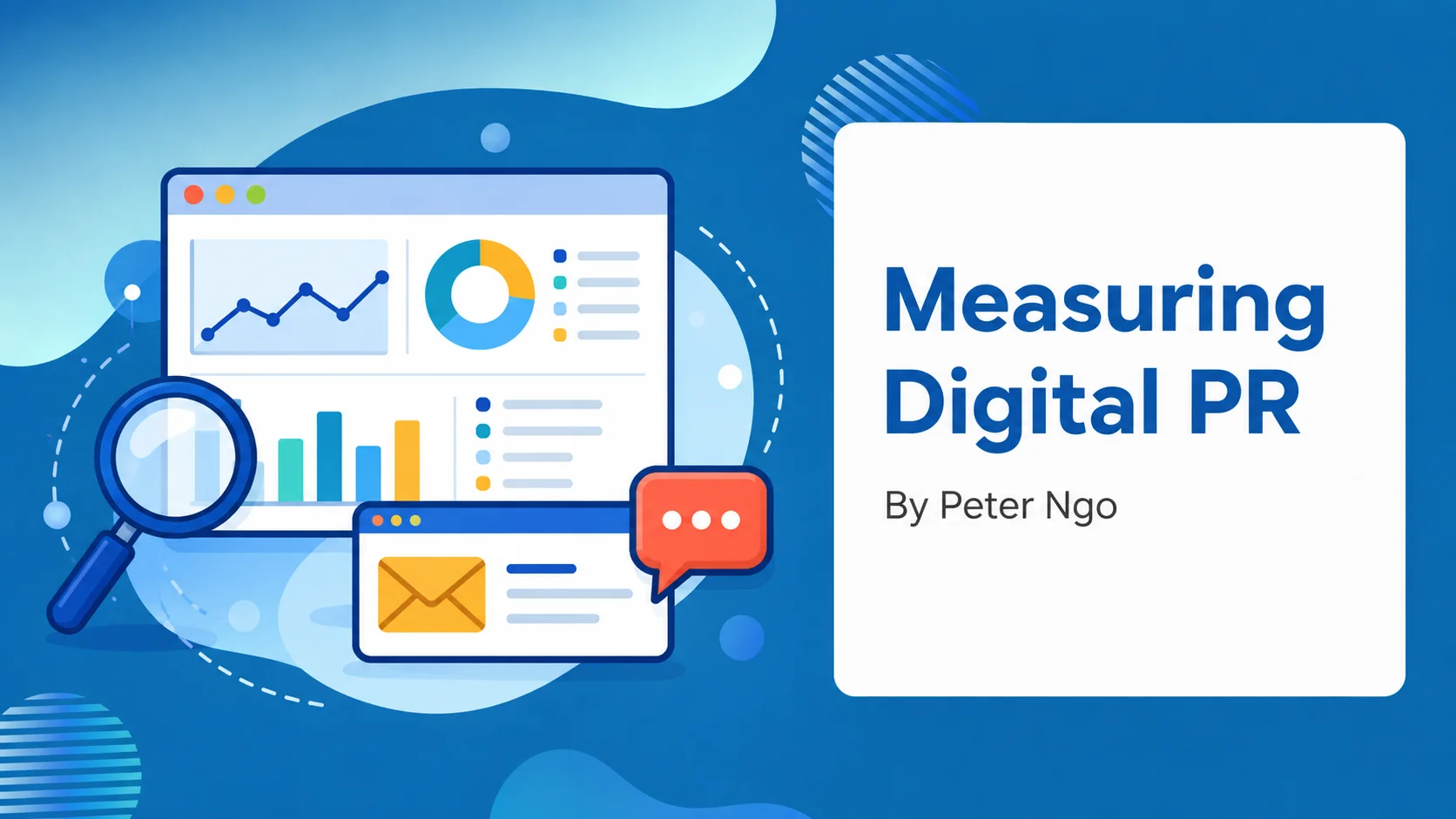
If you’re paying for Digital PR, you probably want to know whether it is helping your business, not just whether someone has sent you a busy report. The difficulty is that coverage, website visits and sales tell you different things, even when they appear beside each other on the same page.
I would want the report to explain what the campaign delivered and how that relates to the result you were paying for. Otherwise, it is easy to read a rise in activity as business growth when the connection hasn’t been established.
What do the numbers actually include?
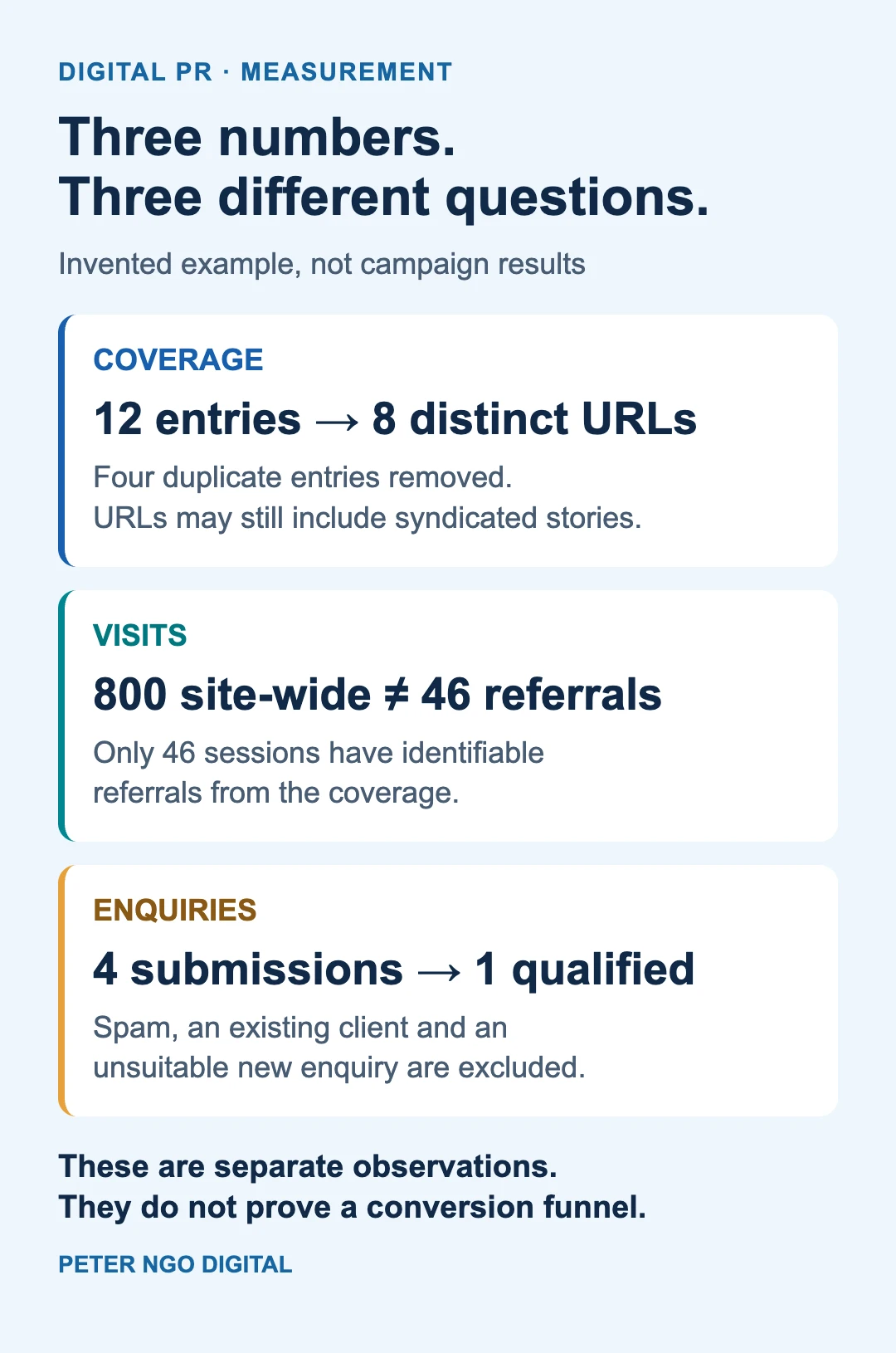
Let’s say your report shows 12 placements, 800 visits and four leads. These are invented figures, but they help explain the problem. When you look at the records, four placement entries are duplicates, leaving eight distinct article URLs. The 800 visits are sessions across your whole website, while only 46 sessions have identifiable referrals from the coverage.
Now look at the four leads. One is spam, one is a request from an existing client and two are new enquiries. Of those two, only one is a good fit for your service. So the report includes one qualified new enquiry, rather than four potential new customers.
You now have eight distinct article URLs, 46 identifiable referral sessions and one qualified new enquiry. But we still don’t know whether that enquiry came from the coverage, and some of those eight articles could be syndicated versions of the same story.
The graphic separates those numbers because each describes something different. It doesn’t show a journey where eight articles brought 46 people to your website and one became a suitable enquiry. We would need more evidence to say that.
Coverage can be a result without proving a sale
If the job was to earn relevant coverage, the articles are evidence that something was delivered. But if you want to know whether the campaign brought in new business, you need more than a publication list to answer that.
The AMEC Integrated Evaluation Framework makes a similar distinction between communications activity, what it produces and the outcomes it contributes to. Getting an article published and influencing someone to buy are different results, so I would not use evidence of one as proof of the other.
You could still value an article because it explains your expertise to potential customers, even if you cannot connect it to a sale. I would describe that as relevant coverage rather than claim revenue that the evidence doesn’t support.
A $10,000 order doesn’t necessarily cover a $6,000 campaign
Let’s say you spend $6,000 on a campaign and then receive a $10,000 order. For this hypothetical example, delivering that order costs $7,000, leaving $3,000 before overheads and marketing. Even if you could connect the order to the campaign, that $3,000 would not cover the $6,000 campaign cost.
The customer might buy again, which could make the relationship more valuable over time. But I would not count future orders as though they had already happened, because you still need those purchases to come through.
That is why I would look beyond the sales figure when discussing whether the campaign paid for itself. How much remained after delivery costs, and how confident are we that the campaign contributed to the sale? Without those answers, the revenue can look encouraging while leaving you unsure whether the spending was worthwhile.
You won’t be able to trace every customer’s decision
Someone could read about your business, remember the name and search for you later on another device. Google Analytics assigns credit using the available data and its settings, as explained in its attribution documentation, but that doesn’t give us a complete account of everything that influenced the customer.
So if you cannot trace an enquiry back to an article, it doesn’t automatically mean the article had no influence. It also doesn’t give us a reason to claim that enquiry as a campaign result.
In my Digital PR work, I would explain what we can see, what it suggests and what remains uncertain. You should be able to have an honest discussion about whether the investment is worthwhile without being asked to accept every positive number as proof that it worked.
Related Digital PR guides
How much does Digital PR cost in Australia? Start with the scope · Digital PR vs link building: which does your business need? · When is a small business ready for Digital PR?